


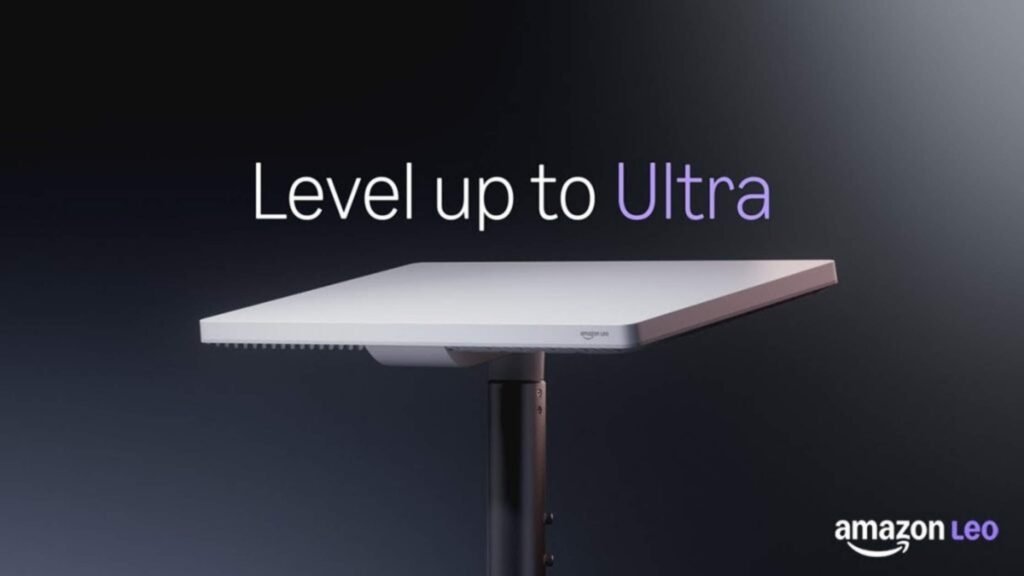
Amazon Leo has launched its fastest customer terminal to date and announced a new enterprise preview program. This step brings the low Earth orbit (LEO) satellite network closer to commercial operations.
The new Leo Ultra antenna delivers gigabit-class download speeds and introduces advanced private networking features, specifically designed for enterprise and public-sector customers. A select group of organizations will now be able to test Amazon Leo services ahead of a broader rollout next year.
Formerly known as Project Kuiper, Amazon Leo has already deployed over 150 satellites into orbit. Initial network testing is already underway, and the company is moving from the deployment phase to early customer adoption.
Enterprise Connectivity Beyond Traditional Networks
Amazon Leo aims to deliver high-speed, reliable internet to locations where terrestrial connectivity is limited or completely unavailable.
This service targets industries such as energy, manufacturing, agriculture, transportation, logistics, and aviation. According to Amazon, this network will fill critical connectivity gaps where secure and low-latency communication is needed—whether in remote or mobile environments.
Chris Weber, VP (Consumer & Enterprise Business), Amazon Leo kehte hain:
Amazon Leo is a huge opportunity for businesses that operate in challenging environments. From satellite and network design to high-performance phased array antennas, we have designed Leo to meet the needs of the world’s most complex enterprise and government customers.
Amazon Leo Ultra Introduction
Amazon has revealed the final production design of the Leo Ultra—an advanced, enterprise-grade customer terminal designed for high-demand applications.
The Leo Ultra uses a full-duplex phased array antenna, which allows for simultaneous uploads and downloads. It features:
- Up to 1 Gbps download speed
- Up to 400 Mbps upload speed
According to Amazon, this is currently the fastest commercial phased array antenna in production.
The antenna’s design is weather-resistant and can withstand extreme temperatures, heavy rain, and strong winds. Its low-profile and no-moving-parts design enables fast installation and requires minimal maintenance.
Custom Silicon and Performance Optimization
At the heart of Leo Ultra is Amazon’s custom-designed silicon chip, which works in conjunction with proprietary RF architecture and signal processing algorithms.
Amazon states that this combination delivers:
- Maximum throughput
- Minimum latency
These features are crucial for enterprise workloads such as real-time monitoring, video conferencing, cloud computing, and remote operations.
The terminal is designed for easy integration with existing enterprise network infrastructure and supports modern IT and cloud-native architectures.
Secure and Private Networking Features
Amazon Leo is not just a consumer broadband service, but is being positioned as a secure enterprise networking platform.
It offers:
- Enterprise-grade encryption
- Network management tools through a web-based console
- 24/7 priority customer support
Additionally, organizations can transfer their data privately without routing it through the public internet.
Direct to AWS and Private Interconnects
Amazon Leo will launch with two major private networking solutions:
1. Direct to AWS (D2A)
Customers can connect directly from Amazon Leo to their AWS workloads—either through AWS Transit Gateway or AWS Direct Connect Gateway. A point-and-click interface makes setup simple and reduces latency.
2. Private Network Interconnect (PNI)
For enterprises and telecom providers, PNI directly connects remote locations to private data centers or core networks. Amazon says these connections can be set up in days, rather than weeks or months, compared to traditional circuits.
Early Enterprise Adoption
Amazon Leo has already signed agreements with customers and partners across several industries, including:
- JetBlue
- Vanu Inc.
- Hunt Energy Network
- Connected Farms
- Crane Worldwide Logistics
JetBlue will use Amazon Leo for its in-flight connectivity strategy.
JetBlue President Marty St. George says:
“Choosing Amazon Leo demonstrates our commitment to providing travelers with a fast, reliable, and flexible free in-flight Wi-Fi experience.”
Energy and Remote Operations Use Cases
Energy companies are among the first to adopt Amazon Leo’s private networking features.
Hunter Hunt, CEO of Hunt Energy Holdings, says:
“We needed exceptional connectivity for our globally distributed energy assets. Amazon Leo’s bandwidth capabilities and secure private link are exactly the solution we needed.”
According to Amazon, these use cases prove that Leo can support mission-critical operations even in locations where traditional connectivity fails.
Enterprise Preview Program Launched
To support early adoption, Amazon has launched an enterprise preview program. Under this program, select customers will be able to test Amazon Leo services with production-ready hardware and software.
During the preview, Amazon will:
- Ship Leo Pro and Leo Ultra terminals
- Collect customer feedback
- Refine industry-specific solutions
The preview program will be expanded as satellite coverage and network capacity increase.
Moving Towards Commercial Operations
Satellites are already in orbit, production hardware is ready, and enterprise testing has begun—Amazon Leo is now very close to full commercial availability.
Amazon says these announcements represent a major milestone, moving the program from deployment to real-world enterprise operations—enabling businesses everywhere to access high-speed and secure connectivity, no matter where they operate.