
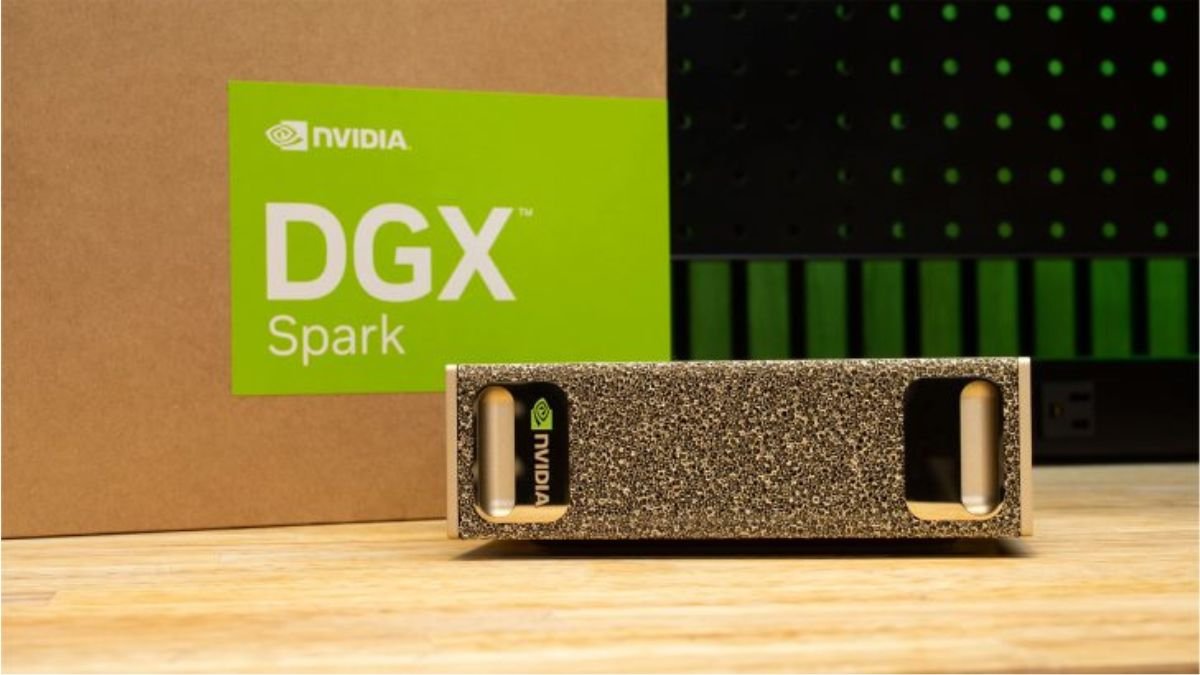
When Nvidia says it has more than doubled the performance of its smallest AI supercomputer, your first instinct might be to expect blazing-fast token generation or a surprise hardware refresh.
That’s not what happened, and that’s exactly why this update matters.
Announced during CES 2026, Nvidia’s latest DGX Spark software release fundamentally changes how the $3,999 AI mini PC feels to use, even though its raw silicon remains the same.
This is a story about latency, software engineering, and why “faster” doesn’t always mean what you think.
The myth: twice the speed means twice the tokens
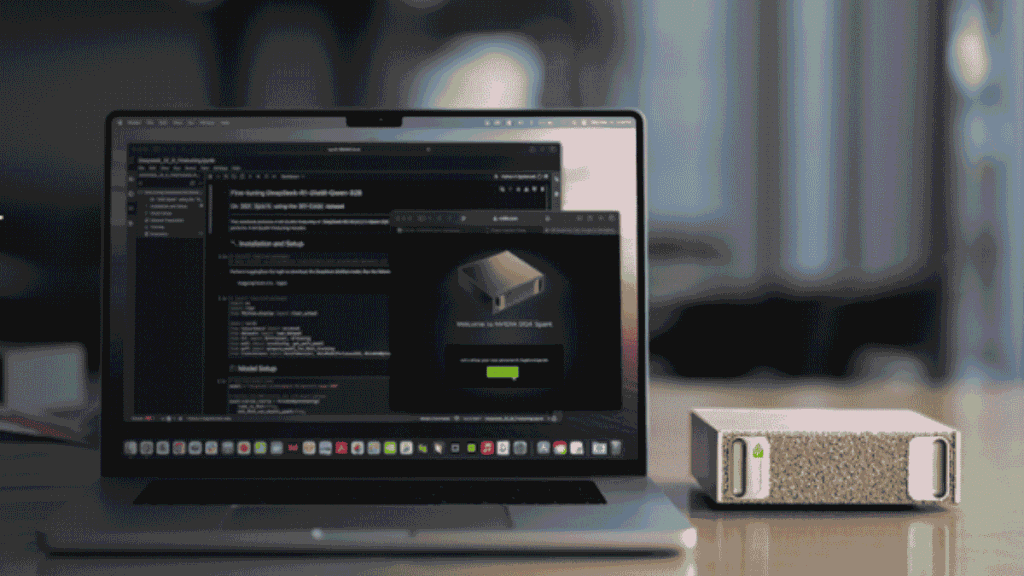
DGX Spark was never designed to compete with data center giants. Its compute capability roughly matches that of an RTX 5070-class GPU, which, on paper, doesn’t scream “supercomputer.”
Yet Nvidia calls it the world’s smallest AI supercomputer for one key reason:
128GB of unified memory, fully accessible by the GPU more than almost any workstation Nvidia sells.
That memory advantage is still intact. What’s new is how efficiently the system uses it.
Despite the headline numbers, DGX Spark will not suddenly generate LLM tokens twice as fast. The decode phase of inference is bandwidth-limited, and no amount of clever software can fully escape that constraint.
Instead, Nvidia targeted something far more noticeable.
Where the real speed boost actually comes from
Since its October launch, Nvidia claims an average 2.5× performance improvement across critical AI libraries — and it all happens before tokens start flowing.
The biggest gains are in prefill performance:
- Faster prompt ingestion
- Reduced time-to-first-token
- Smoother interactive AI sessions
In real-world use, that means:
- Less waiting after hitting “Enter”
- Faster feedback when testing prompts
- Quicker iteration when fine-tuning or experimenting locally
For developers, that matters more than raw token throughput.
Under-the-hood upgrades are doing the heavy lifting
NVIDIA tuned nearly every major piece of the generative AI stack, including:
- TensorRT-LLM
- Llama.cpp
- PyTorch
These optimizations don’t just help language models. They also improve:
- Image generation
- Video workflows
- Model fine-tuning
- Other compute-heavy AI tasks
In short, DGX Spark now responds like a much faster system — even though the hardware hasn’t changed.
AI Enterprise is coming, and that’s a big deal.
NVIDIA also confirmed that AI Enterprise is arriving on DGX Spark as a subscription later this month.
Normally priced at around $4,500 per GPU per year, the suite includes:
- Enterprise-grade frameworks
- Optimized models
- Microservices for production AI apps
NVIDIA says special pricing for Spark users is planned, though details are still pending. Developers can use it for free, but production deployments will require a paid license.
For a desktop AI system, this effectively brings data-center software tooling down to a single-box workstation.
Long-term support fears, addressed (mostly)
When DGX Spark launched, some buyers worried it could become obsolete if DGX OS stopped receiving updates — a fate that hit older Nvidia boards in the past.
NVIDIA says that won’t happen here.
The company has already released new kernels with security patches and hinted at future alignment with Ubuntu 26.04 LTS. That said, official support for third-party distros like Red Hat Enterprise Linux is still not available.
For now, Nvidia is all-in on DGX OS — but continued updates reduce the risk of Spark becoming an expensive paperweight.
CUDA assistants, game modding, and robots
The software push doesn’t stop at AI models:
- A local Nsight CUDA coding assistant is coming later this spring, removing the need for cloud-based inference.
- RTX Remix support lets developers offload AI-assisted game modding tasks to Spark.
- NVIDIA is working with Hugging Face to pair DGX Spark with the Reachy robot for embodied AI development.
This positions Spark as a multi-disciplinary AI workstation — not just an LLM box.
Spark clusters could be next.
Every DGX Spark includes a ConnectX-7 NIC with dual QSFP+ ports delivering up to 200Gbps of interconnect bandwidth.
Today, Nvidia officially supports linking two systems. Internally, the company says it’s already seeing demand for larger Spark clusters — and engineers are actively exploring that path.
If that happens, DGX Spark could quietly evolve from a “tiny AI supercomputer” into a modular, desk-scale AI cluster.
Why this matters for Google Discover readers
This isn’t a flashy hardware launch. There’s no new chip. No bigger number on the spec sheet.
But it’s exactly the kind of update that signals where AI hardware is heading:
- Software-first performance gains
- Lower latency over higher peak numbers
- Enterprise tools trickling down to desktop systems.
DGX Spark didn’t just get faster. It got smarter — and that’s the kind of shift most people don’t notice until it’s everywhere.
If Nvidia keeps pushing updates like this, the smallest DGX system might end up being one of its most influential.